

Free Consultation



A W-2 is the annual wage and tax statement your employer sends to you and the IRS. It reports your taxable wages, withheld federal income tax, Social Security tax, Medicare tax, and any benefits or deductions that affect your annual tax return. The IRS uses the W-2 to verify the income you report and the taxes your employer withheld on your behalf.
W-2 forms are important because they document your annual wages and the exact taxes your employer withheld, and the IRS uses this data to verify your tax return. The form also determines your refund or balance due by showing how much tax you already paid through payroll withholding.

You should receive your W-2 form no later than January 31 because employers must distribute all W-2s by this IRS deadline. Employers may send the form by mail, provide digital access, or deliver it in person, but the form must be available by the same date.
What If You Don’t Receive a W-2 Form?
You should request your W-2 from your employer when it is missing after January 31 because the IRS requires employers to issue it by that deadline. If the employer does not respond, you can contact the IRS for assistance, and the agency will request the form directly from the employer.
What If You Find an Error on Your W-2 Form?
You should contact your employer immediately when you find a W-2 error because only the employer can issue a corrected Form W-2c. Incorrect wages, tax withholding, or personal information must be fixed before you file your tax return to prevent IRS mismatches.
Your W-2 contains numbered boxes that summarize your annual wages, taxes, and benefits. Each box reports a specific category of income or withholding, and understanding these entries helps you match your payroll data with what you report on your tax return.
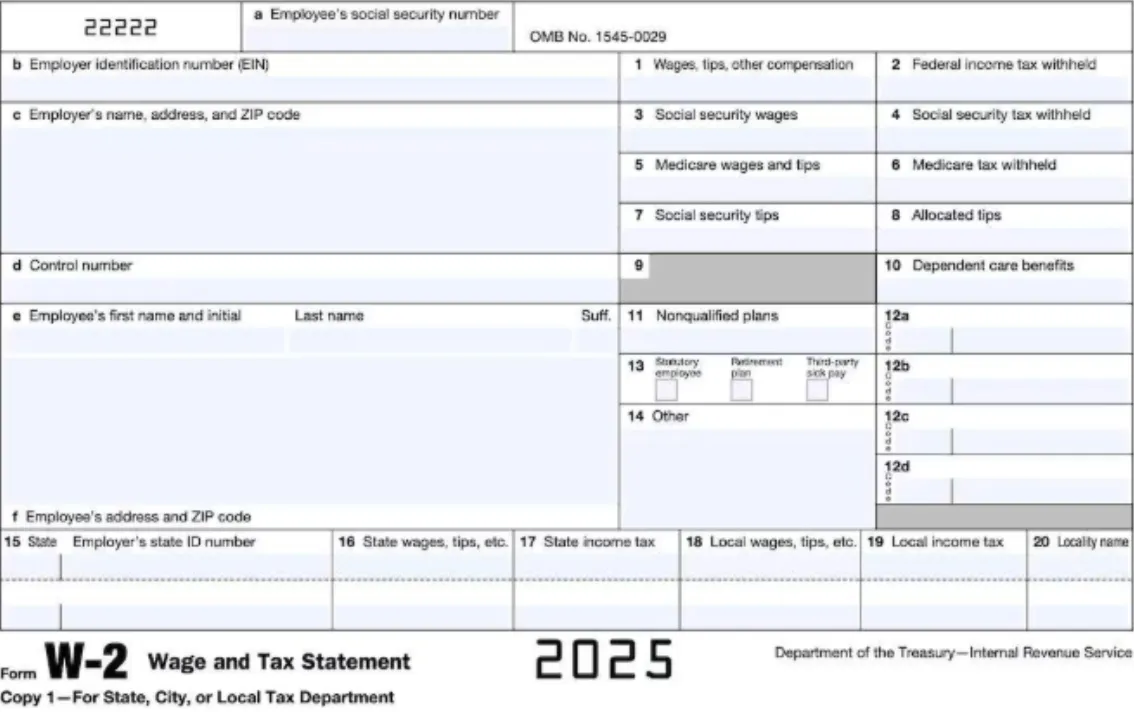
Box 1 shows your taxable federal wages, which are your gross earnings minus pre-tax deductions such as 401(k) contributions, health insurance premiums, and FSA amounts.


Box 2 lists the total federal income tax your employer withheld during the year. This amount directly affects your refund or balance due.
Box 3 reports Social Security-taxable wages, capped at the annual Social Security wage base. Box 4 shows the 6.2% Social Security tax withheld.


Box 7 reports allocated tips.Box 8 reports tips your employer assigned for reporting purposes, often used in hospitality or service industries.
Box 10 displays employer-provided dependent care benefits, including amounts contributed to a dependent care FSA.


Box 12 uses letter codes to identify specific wage or benefit items such as retirement contributions (Code D), employer health coverage value (Code DD), HSA contributions (Code W), and others. Each code affects your tax return differently.
Box 13 marks whether you were in a retirement plan, received statutory employee wages, or were eligible for third-party sick pay.


Box 14 includes optional employer entries like union dues, state disability insurance, or tuition assistance that do not fit in other boxes.
Boxes 15–20 report state and local wages, state tax withheld, local tax withheld, and corresponding employer identification numbers, depending on your state’s requirements.


Safeway Tax helps you interpret your W-2 by having licensed tax professionals review every wage, tax, and benefit entry for accuracy, explain how each box affects your refund, and identify discrepancies that may cause IRS mismatches.
A licensed professional also checks for missed deductions, pre-tax benefits, or withholding issues that may influence your tax outcome. This guidance helps you avoid filing errors, catch employer mistakes early, and maximize the accuracy of your return with expert oversight.
Once submitted, your information is reviewed by an IRS Relief Specialist, who will follow up to explain which IRS relief options may apply and answer any questions you have.
SafewayTax helps individuals and businesses address complex tax issues. By providing a few details, our team can quickly review your situation and help you move forward with confidence
© Copyright 2026 SafewayTax | All Rights Reserved.


Any estimates, projections, or statements on the Website regarding potential program performance are based on historical outcomes and client testimonials that reflect individual circumstances. Results depend on the specific facts of each client’s situation and may vary significantly. Your outcomes will depend on factors including, but not limited to, your financial condition and your ability to provide SafewayTax with complete, accurate, and timely information.
You are encouraged to carefully review all program materials before enrolling in any Service.
SafewayTax does not guarantee that your tax liability will be reduced by any specific amount or percentage, that your taxes will be resolved within a particular timeframe, or that you will qualify for any Internal Revenue Service (“IRS”) program or relief option. Interest and penalties may continue to accrue until your tax liability is fully satisfied with the IRS.
SafewayTax is an independent tax resolution firm and is not affiliated with or endorsed by the IRS. We do not assume your tax liabilities, make payments to creditors on your behalf, or provide legal, accounting, bankruptcy, or formal tax advice unless expressly stated in a separate written agreement. Services may not be available in all states, and fees may vary depending on jurisdiction and case complexity.
By providing your contact information, you expressly consent to receive communications from SafewayTax, including phone calls and SMS text messages, at the telephone number you provide. Such communications may include service-related updates, marketing messages, and other informational notices. Standard messaging and data rates may apply, and you are responsible for any charges imposed by your carrier.